As the discourse around generative A.I. continues to consume higher education, the arts, and the economy, one consideration that’s easy for creatives to overlook is exactly how generated content is treated under the law. Sure, you can generate an illustration or video in the time it took me to type this sentence, but what can you legally do with it?
For the moment, I’m setting aside the ethical debates over energy use and training data, and the fact that A.I. content trends toward mindless slop. These are important considerations when deciding to use generative A.I., but it’s possible that knowing the state of A.I. legality could help bypass these thornier questions entirely.
This post is not definitive legal advice. I’m not a lawyer! It’s simply based on my own research.
First, what is copyright?
Copyright is a way of claiming and protecting authorship of creative work, as written in the U.S. Constitution — that’s right! Article ONE of the Constitution has a section about art. Other countries have similar laws, but they will vary from place to place.
According to this official overview document, U.S. Copyright protects any “original works of authorship” that are fixed in perceivable form and “possess at least some minimal degree of creativity” (lol). This includes, but is not limited to:
- Literary works
- Music
- Dance or other performances
- Cinematic works and video
- Pictorial, graphic, and sculptural works
- Computer programming code
The author of a copyrighted work has the sole right to reproduce, distribute, adapt, or display the work for the duration of their lifetime (plus 70 years for their descendants).
Can I copyright works generated by AI?
No.
According to a 2024–2025 report issued by the U.S. Copyright Office, “copyright can protect only material that is the product of human creativity” and legal protection “excludes non-humans.” (p. 2)
The report offers a nice analogy to other forms of digital or electronic art:
For example, a visual artist who uses Adobe Photoshop to edit an image remains the author of the modified image, 36 and a musical artist may use effects such as guitar pedals when creating a sound recording. In each case, what matters is the extent to which the human had creative control over the work’s expression and “actually formed” the traditional elements of authorship (p. 4)
In this valuable article about AI-generated logos, Bloomberg Law writes that a logo generated from a text prompt would not be eligible for copyright, but if you begin with a hand-drawn logo and enhance or modify it with A.I., that could qualify. They stress the importance of preserving the original hand-drawn sketch!
When submitting a U.S. copyright application, creators are instructed to describe their use of A.I. in the “Author Created” field. For example, if AI-generated text is incorporated into a larger work, only the portions of the work that are human-authored may be copyrighted. While a human might “direct” an A.I. to create an image or text, because the results are unpredictable and variable, the law would not support the idea that the human is the true author of the work. Despite this, the report makes clear that A.I. systems should not be listed as co-authors — the A.I. is a tool.
Similar to what many teachers and colleges ask, if you do use A.I. as a tool, you should acknowledge its use and make clear what portions of the work it created and what your own contributions are through documenting your process.
If AI-generated content is significantly edited by a human, or arranged in a sophisticated and creative way, then it may be eligible for copyright on a "case-by-case basis," according to Bloomberg Law. But its your responsibility to show evidence that you had “creative control” of the work.
What if I simply don’t disclose the use of AI?
If you try to pass off AI-generated work as your own, your copyright may be denied or reversed.
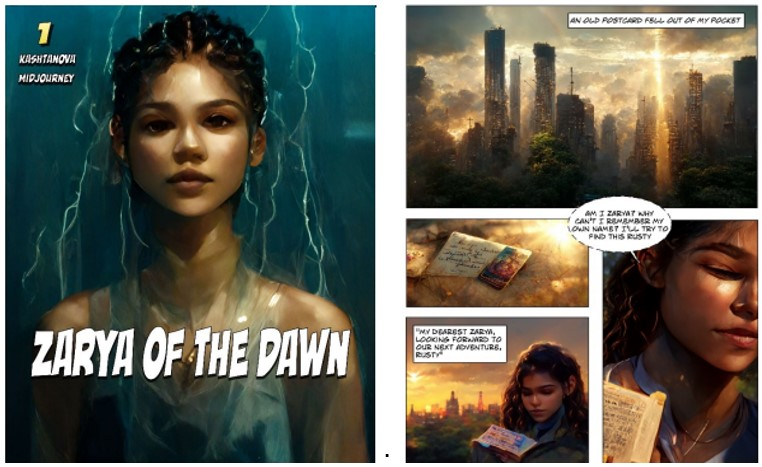
In 2023 the Copyright Office invalidated the copyright of a graphic novel called Zarya of the Dawn. Author Kristina Kashtanova used Midjourney to create the artwork for the book, and when questioned by the Office about her claim of authorship, she described using “hundreds of iterations” and post-processing of images. But this was apparently not enough to qualify as “creative control.” According to the Office’s ruling:
The process by which a Midjourney user obtains an ultimate satisfactory image through the tool is not the same as that of a human artist, writer, or photographer […] the initial prompt by a user generates four different images [and] the process is not controlled by the user because it is not possible to predict what Midjourney will create ahead of time.
Plus knowingly lying to the government in your copyright application is fraud.
As artists, filmmakers, and writers continue to experiment with A.I. tools, some may invent workflows that do display enough “creative control” to qualify for copyright, but it’s uncharted legal territory!
Wait, do I need to file a copyright for my creations?
Technically no!
The rights of authorship are presumed from the moment of creation — when your idea takes tangible form.
You can simply write © (option G on Mac) alongside your name and the year, to provide notice that you’re claiming copyright of a work. This serves as a public record and can strengthen your case if anyone ever does copy, reproduce, or distribute your work without permission.
But you can register your work with the U.S. Copyright Office for added proof of your authorship.
What about work created for a client?
As A.I. features and their accompanying sparkles ✨ appear in more and more creative software, the possibility of generating a logo, writing, or other media is practically thrust in your face.
So what would happen if a graphic designer uses A.I. to generate a logo for their client?
As the AIGA explains, “paying for your [design] services does not automatically grant your clients copyright. The copyright remains yours.”
In theory, if a client wants to reuse or modify your designs after an initial job, they ought to request your permission as the copyright holder. So in many contracts, clients might ask the designer to sign over the copyright for the work created. This would grant them the right to modify and use the logo however they want, limit the designer’s ability to reproduce or even re-sell the design, and myriad other legal protections.
Another option for freelancers, is to maintain ownership of the copyright, but grant specific usage-rights to the client, such as the ability to re-produce or edit the designs according to specific criteria. You can even charge them royalties to use your designs, though you probably wouldn’t want your contract to be too off-putting to the client. 😉
Handing your client AI-generated work — especially if not disclosed — could limit their ability to use the design because they would not actually be able to copyright it. And because AI-generated content is based on the model's training data, a generated logo could unintentionally violate somebody else's copyright if it uses recognizable details! This applies to other creative work-for-hire like photography, videography, illustration, and writing.
Trademarks
What your client probably cares about more, is the legal protection of trademark to your logo.
As the name implies a trademark is any graphic, word, or recognizable aspect of a commercial entity. Besides logos, some novel trademarks include iconic soundmarks like the THX deep note or the smell of Playdough!
This is the concern of the client rather than the hired designer, and the client can put the ™️ symbol next to your logo to claim it as a trademark or (similar to copyright) register their trademark with the federal government for the legally superior ®️ symbol.
And notably, an AI-generated logo could still be protected as a trademark.
If a designer chooses not to transfer the copyright of their work to a client — perhaps to maintain a stake in the creative direction of the brand — the client could still trademark the logo.
If a business trademarked their logo, but didn’t acquire the copyright from the designer, they could use it to promote their brand but could run into problems if:
- The designer objected to future redesigns or uses of the logo, such as licensing or merchandise.
- The designer reused the logo in a different market context.
- The business wanted to sell to a new owner, and lacked ownership of the valuable I.P.
Ugh, so what do I need to do as a designer?
Whether you’re working for hire or employed by a company, be cognizant of the intellectual property you’re involved with. If you “create” or “author” something original, then you are the copyright owner of that I.P.
Be mindful of assets you use
Designers often use assets they did not create from scratch, such as fonts, photographs, icons, text, templates, and so on. Whether these are found online or generated by A.I., keep track of these assets and their copyright status in a spreadsheet or document.
- Check Creative Commons assets to see if attribution is required.
- If assets might be copyrighted by another person, it must be modified beyond recognition to qualify for fair use.
- AI-generated assets cannot be copyrighted! So if you use them, your work will not have any legal protection of ownership.
- If using A.I. tools, read the Terms of Use from the app to see what restrictions they might impose on the generated material. For example, some tools might expressly forbid you from using the generated content for commercial purposes or licensing them to other people.
- Whenever possible use assets from the public domain — they can be surprisingly cool!
Always use a contract when freelancing
As a freelancer, always use a contract to clarify ownership of I.P. along with your rates, schedules, and deliverables. AIGA offers contract templates and resources to get you started, but even a simple agreement in plain english is better than nothing.
You might include a statement in your contract that grants you permission to show the work in your portfolio, for example.
Regarding A.I., remember that AI-generated work can not by copyrighted. Relying too much on A.I. could make it difficult to use or profit from creative work in professional settings.
If you might use A.I. in your design process, you might include a statement in your contract to that effect, so that the client doesn’t try to renege on payment later.
Document your process
A good habit for any designer is to document the evolution of your work through photographs, notes, or screenshots. This can be great to include in your portfolio or to share with clients to demonstrate the depth of your work — and it can also prove that your work was not generated by A.I.
Consider documenting:
- Early sketches
- Notes
- Drafts
- Email correspondence or feedback (”you said to make the logo bigger!”)
- Version history (Figma and some apps save this automatically; use git for code projects).
What if I’m a student?
College students usually don’t bother copyrighting their work — or stressing about using other people’s copyrighted work — unless it’s actively distributed to the public.
But do practice documenting your process as described above. That way, you can prove to your teachers that you actually created your work in case they accuse you of over-using A.I. 😉 Documenting your use of A.I., such as specific prompts or raw output, can help make it clear to everyone where certain work or ideas came from and what you are (or are not) learning.
I hate this, why do we have copyright?
Besides protecting your exclusive rights to distribute, reproduce, modify, and control the public dissemination of your work, copyright was specifically conceived to benefit society by creating a pipeline to bring ideas and art into the public domain.
Copyright protects your I.P. for your life plus 70 years, and then it expires. This ensures that creative work eventually becomes free to use, remix, and enrich our shared culture.